FADO brand
  News
News  Projects
  Career's
  All categories
  Engineering plumbing
  Heat pumps and boiler equipment
  Designer plumbing
 Technical support
  Marketing support
  Dealers
  For installers
  To projectors
  Warranty
  FAQ
FAQ 


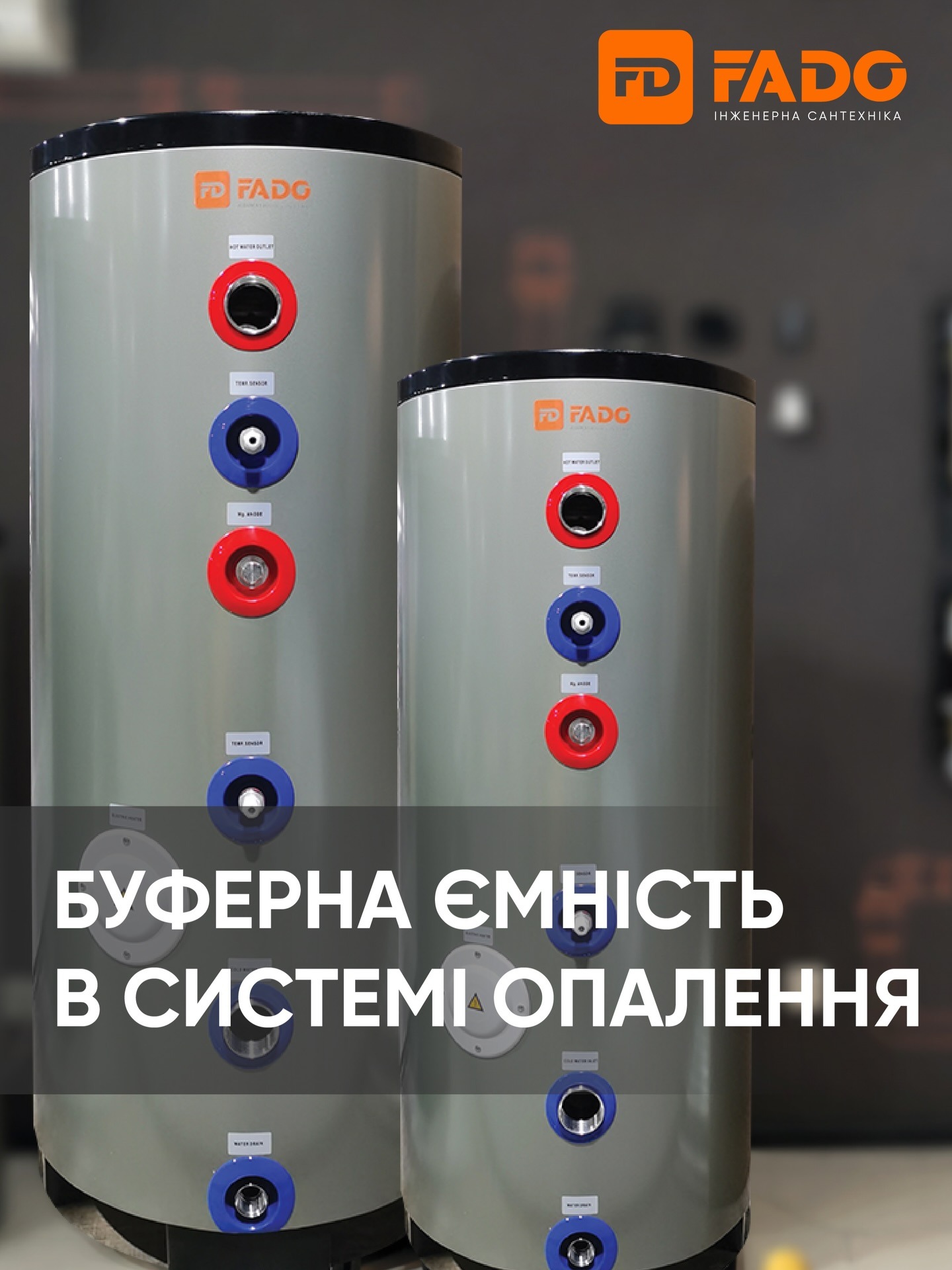
In modern engineering design buffer capacity (or heat accumulator) has ceased to be an additional element and has become a critical part of an energy-efficient system. It is a special sealed reservoir that accumulates excess heat energy from the heat generator and transfers it to the heating circuits exactly when it is needed.
In essence, the buffer tank acts as a «thermos» or energy buffer that allows the system to operate stably, regardless of instantaneous consumption peaks or boiler operation.
Key advantages of using buffer capacity
The introduction of a heat accumulator into a heating system solves a number of technical and economic problems:
1. Maximum efficiency and stability of the heat generator
The buffer capacity allows the boiler (especially solid fuel models) to operate at optimum full capacity, where the fuel is burned as efficiently as possible. This significantly reduces the number of on/off cycles («tapping»), which reduces wear and tear on the equipment and extends its service life.
2. Significant resource savings
Excess heat, which usually just «flies out the window» or overheats the room, is stored in a container. This makes it possible to use the accumulated heat even when the boiler is already turned off. The greatest economic effect is observed in connection with heat pumps and solid fuel boilers.
3. Uniform temperature and comfort
The heat accumulator smoothes out sudden temperature spikes. The flow of coolant to radiators or underfloor heating becomes smooth and stable, eliminating discomfort from temperature fluctuations in the rooms.
4. Conflict-free integration of multiple heat sources
A buffer tank is an ideal place to combine energy from different sources: a gas boiler, a heat pump, an electric boiler or solar collectors. It allows different units to operate in a single network without hydraulic conflicts.
5. Hydraulic decoupling and system protection
The use of a container allows you to separate the heat generation circuit and the consumption circuit (radiators, underfloor heating). This minimizes noise in the system, prevents overheating and condensation, which protects metal parts of the equipment from premature corrosion.
When is the installation of a buffer capacity mandatory?
Experts recommend that you include a heat accumulator in your project if the following factors are present in your system:
-
Solid fuel boiler: to safely discharge excess heat and prevent boiling.
-
Heat pump: to provide the required coolant volume during defrost cycles and reduce the number of compressor starts.
-
Underfloor heating system: for precise maintenance of low temperature conditions.
-
Combined systems: when two or more heat sources are used in one building.
-
Large objects: for balanced energy distribution in complex circuits.
A well-thought-out engineering system is not just about having a heat source, but about managing it competently. A buffer tank is an investment that pays off by reducing fuel costs and avoiding the cost of premature equipment repairs.
Choose professional solutions for stable heat in your home for years to come.