FADO brand
  News
News  Projects
  Career's
  All categories
  Engineering plumbing
  Heat pumps and boiler equipment
  Designer plumbing
 Technical support
  Marketing support
  Dealers
  For installers
  To projectors
  Warranty
  FAQ
FAQ 


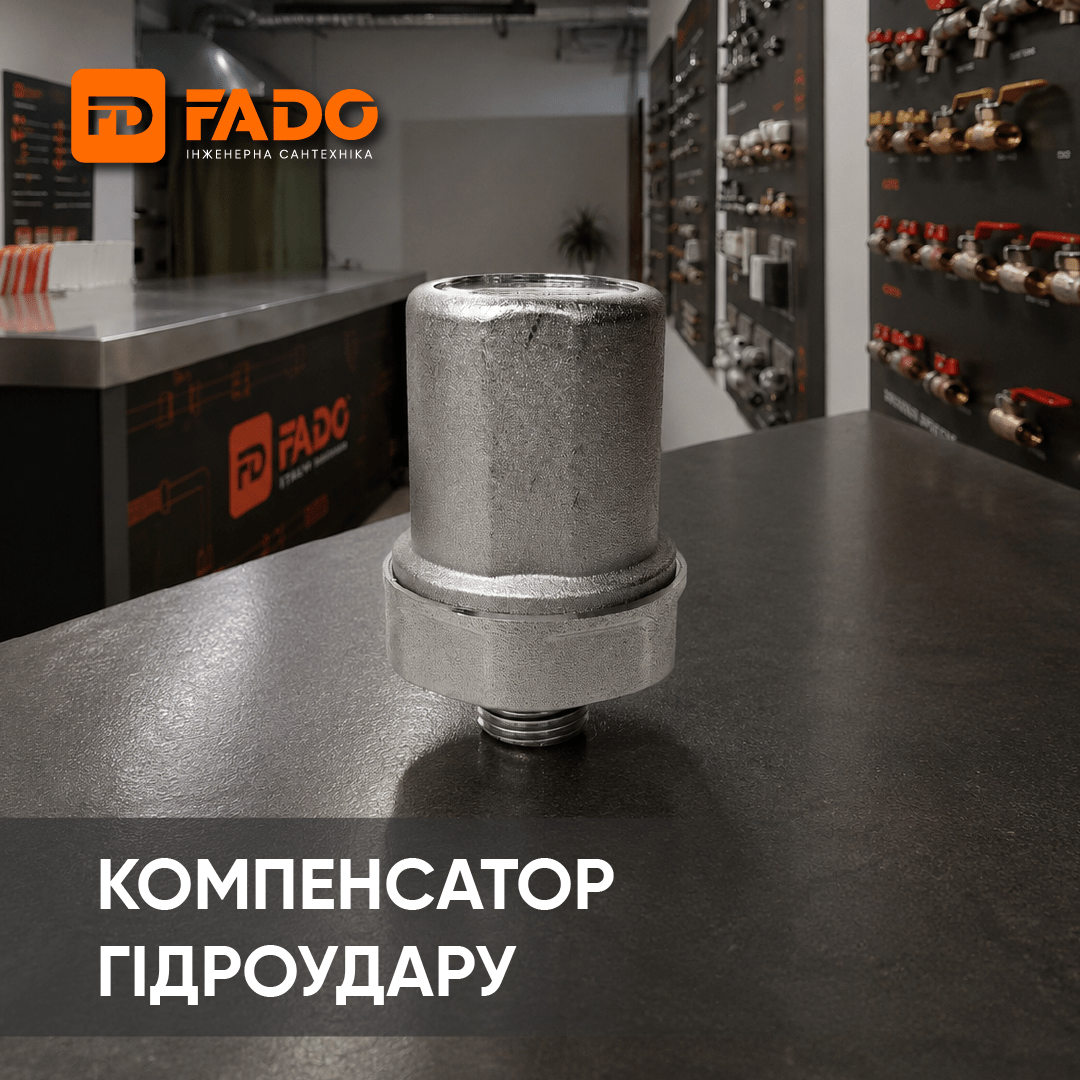
A distinctive loud click or thud in the plumbing when a faucet is suddenly turned off or a washing machine or dishwasher is turned off is a classic symptom water hammer.
This physical process poses a hidden threat to utility systems, as regular pressure surges lead to premature wear of connections, damage to valves, and the risk of emergency leaks.
The Mechanics of Water Hammer and Its Effects
A water hammer occurs as a result of a sudden change in the velocity of a fluid flowing through a closed circuit. When a solenoid valve in a household appliance or a lever-operated faucet instantly shuts off the flow, the kinetic energy of the water is converted into a pressure surge. The resulting compression wave travels through the pipeline in the opposite direction.
The main consequences of regular water hammer:
-
Damage to the flexible hoses on washing machines and dishwashers.
-
Failure of measuring instruments (meters, pressure gauges).
-
Leaks in threaded and press-fit connections.
-
Microcracks in filter housings and water heater tanks.
How the FADO CWH01 Water Hammer Suppressor Works
A water hammer arrester is used to isolate and dampen these pulses FADO CWH01. The device operates on the spring-piston principle:
-
When a pressure surge occurs, the excess energy of the water column presses against the inner piston.
-
The piston compresses the stainless steel damping spring, absorbing the main hydraulic load.
-
Once the pressure in the system has stabilized, the spring returns the piston to its original position.
As a result, the pressure peak is absorbed directly at the point where it occurs, without propagating further through the system.
Technical Specifications of the FADO CWH01
| Parameter | Meaning. |
| Body material | Stamped brass (CW617N) |
| Spring material | Stainless steel |
| Sealing Elements | EPDM (ethylene-propylene rubber) |
| Connection size | ½” (external threaded connection) |
| Nominal operating pressure | 10 bar |
| Maximum pressure (failure/peak) | 50 bar |
| Maximum operating temperature | +90 °C |
Installation Recommendations
To achieve maximum protection, the FADO CWH01 compensator should be installed in accordance with the following guidelines:
-
Localization: The device should be installed as close as possible to the source of a potential water hammer—in front of the solenoid valves on washing machines or dishwashers, near manifold blocks, or in front of storage water heaters.
-
Spatial Orientation: The compensator can be installed in either a vertical or horizontal position.
-
Maintenance: Thanks to the absence of wear-prone diaphragms and the use of a stainless steel spring, the FADO CWH01 requires no regular maintenance after installation.
Installing the FADO CWH01 water hammer arrestor is an affordable and effective way to protect household appliances and plumbing systems from sudden pressure surges, thereby extending the service life of the entire water supply system.
You can purchase equipment and receive professional advice on system design from official FADO dealers or at specialty DIY stores.
FADO — reliable engineering solutions for the security of your home.